
1. INTRODUCTION
Red mud, also referred to as bauxite residue, is an unavoidable by-product of alumina production from bauxite ore and consists mainly of insoluble mineral phases together with residual alkaline processing chemicals. Depending on the quality of the processed raw material, approximately 1–2.5 t of red mud is generated per ton of alumina produced, making its management a major environmental challenge (Paramguru et al., 2005). Globally, around 120 million tonnes of red mud are produced annually, and this quantity continues to increase with growing aluminium demand (Power et al., 2011). Owing to its high alkalinity, fine particle size, and large storage requirements, red mud represents a significant long-term environmental burden (Milačić et al., 2012). The environmental risks associated with red mud were clearly demonstrated by the Ajka spill, where the release of highly alkaline residue caused extensive contamination of terrestrial and aquatic ecosystems (Milačić et al., 2012). Remote sensing proved valuable for rapid assessment of the affected area (Berke et al., 2013), while long-term monitoring indicated gradual recovery of soils, sediments, and aquatic ecosystems (Mayes et al., 2016).
Research on red mud has expanded considerably during recent decades, focusing on residue management, resource recovery, wastewater treatment, and sustainable reuse (Svobodova-Sedlackova et al., 2024). Recovery of valuable metals and rare earth elements supports circular economy principles, while the reuse of red mud in construction materials is often limited by its alkalinity and potential toxicity. Alternative management approaches include ecological soilization and revegetation (Jia et al., 2024). In addition, seawater neutralization has been shown to enhance the anion-removal capacity of red mud through the formation of Bayer hydrotalcite (Palmer et al., 2010). Red mud has also been investigated as a low-cost adsorbent for wastewater treatment; however, its adsorption efficiency strongly depends on its composition and pretreatment, and chemical or thermal activation is often required to improve its performance (Sahu, 2017; Wang et al., 2019).
Surface waters and ponded wastewater associated with red mud disposal sites are characterized by high alkalinity and elevated concentrations of dissolved contaminants, requiring treatment prior to discharge. Previous studies have demonstrated the effectiveness of sulfuric acid neutralization for reducing alkalinity in bauxite residue leachates (Kishida et al., 2017; Toli et al., 2023). Calcium-based amendments, including lime and limestone, promote pH reduction and carbonate precipitation (Higgins et al., 2018), while citric acid has been proposed as a milder alternative for neutralizing alkaline residues (Kong et al., 2017). Zeolite materials have shown good adsorption performance for dissolved metals in industrial wastewaters (Belviso et al., 2023; de Magalhães et al., 2022; Maftei et al., 2025). Ion-exchange resins have been successfully applied for the removal and recovery of contaminants from highly alkaline bauxite residue leachates. Gomes et al. (2016) demonstrated the efficient removal and recovery of vanadium using anion-exchange resins, while Tsakanika et al. (2015) reported the selective recovery of rare earth elements using cation-exchange resins. These studies demonstrate the potential of both anionic and cationic ion-exchange resins for the treatment of alkaline bauxite residue leachates.
Because the physicochemical characteristics of red mud basins vary considerably, a treatment method effective at one site cannot be directly transferred to another. At the former aluminium plant in Podgorica (Montenegro), wastewater retained in the red mud disposal basins exhibits high alkalinity (pH > 10) together with elevated concentrations of Al, As, V, and F. Therefore, the aim of this study was to evaluate five laboratory treatment methods and identify the most effective treatment strategy for reducing alkalinity and contaminant concentrations to levels that comply with the applicable environmental standards.
2. MATERIALS AND METHODS
Based on the site characteristics and the initial physicochemical characterization of the basin waters, laboratory experiments were conducted to evaluate five treatment methods for reducing alkalinity and removing Al, As, V, and F from wastewater collected from the two red mud disposal basins. The study combined site characterization, water quality assessment, mineralogical analysis of red mud, TCLP testing and laboratory treatment experiments to identify the most effective remediation strategy.
2.1. Study area and site characterization
The investigated site comprises two red mud disposal basins located at the former aluminium plant near Podgorica, Montenegro (42°23′00.17″ N, 19°13′08.17″ E), approximately 10 km south of the city and about 600 m from the Morača River, which flows into Lake Skadar. The landfill is situated in close proximity to Skadar Lake National Park, one of the largest protected wetland areas in Montenegro. Red mud, generated during the Bayer processing of bauxite ore, was disposed of in large open basins adjacent to the former industrial facility. Although disposal activities have ceased and no additional red mud is currently being deposited, the majority of the residue remains stored as an alkaline slurry in two main basins (A and B), covering a total surface area of approximately 0.45 km² (Figure 1). A significant portion of the landfill surface is permanently covered by water originating from pipeline washing and precipitation, which reduces dust emissions during dry periods.
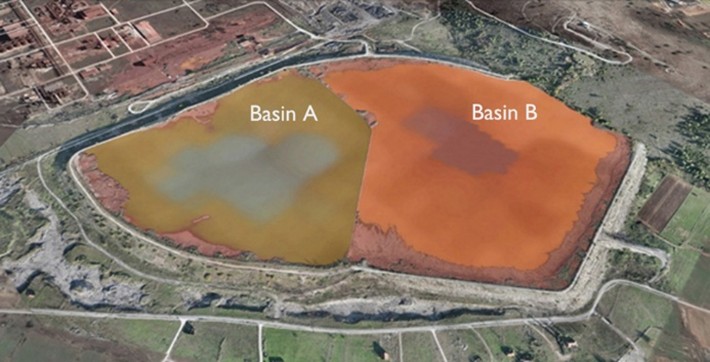
Wastewater samples for this study were collected from two red mud disposal basins (Basin A and Basin B). Five surface water samples (approximately 3 L each) were collected from different locations within each basin and combined to obtain one composite sample (approximately 15 L) representative of each basin. The canisters were transported to the laboratory and stored at 4 °C until analysis. Prior to laboratory testing, each composite sample was individually homogenized and divided into 1 L aliquots for the subsequent treatment experiments, ensuring an identical initial water composition for all investigated methods.
The physicochemical characterization of the collected wastewater included determination of pH and dissolved element concentrations. Aluminium was determined by ICP-OES (Spectro Ciros Vision), whereas arsenic and vanadium were determined by ICP-MS (Agilent 7700). Fluoride concentrations were determined spectrophotometrically. The pH values were measured using a calibrated laboratory pH meter.
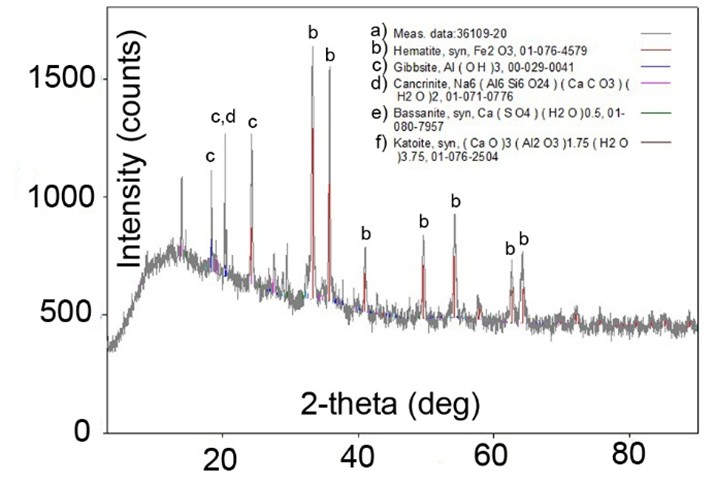
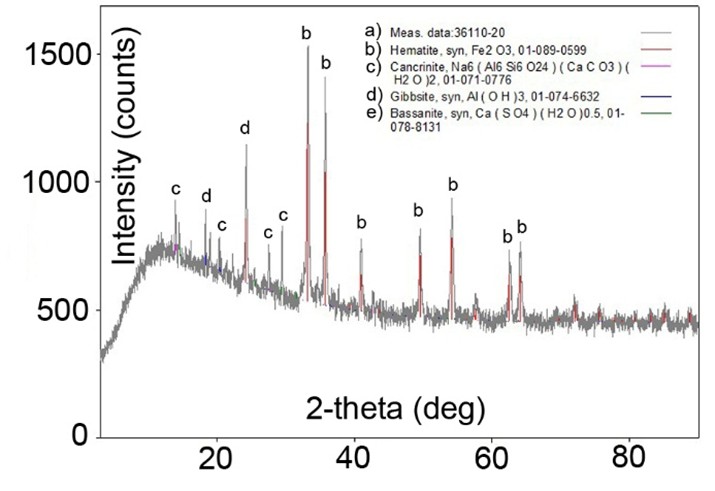
The mineralogical composition of the red mud was characterized by X-ray diffraction (XRD). XRD analysis was performed using a Rigaku MiniFlex 600 diffractometer equipped with a D/teX Ultra 250 high-speed detector and an X-ray tube with a copper anode. Measurements were collected over an angular range of 3–90°, with a step size of 0.02° and a scanning speed of 10°/min. The tube voltage and current were set to 40 kV and 15 mA, respectively. Mineral phases were identified using PDXL 2 software (Version 2.4.2.0), and the obtained diffractograms were matched against the ICDD PDF-2 2015 database. The XRD detection limit is approximately 1%.
Given that the retained basin water remains in direct contact with the deposited red mud, the leaching potential of the solid material was additionally evaluated to provide a more complete understanding of the solid–liquid system controlling water composition. Therefore, the Toxicity Characteristic Leaching Procedure (TCLP) was performed according to US EPA Method 1311.
Based on the preliminary pH determination, Extraction Fluid 1 was selected and prepared according to EPA Method 1311, with a final pH of 4.93 ± 0.05. Prior to extraction, the red mud samples were homogenized and, where necessary, reduced to a particle size of < 9.5 mm. The extraction was performed using a liquid-to-solid ratio of 20:1 (L kg⁻¹). Samples were agitated in 1 L glass bottles for 18 ± 2 h at 30 ± 2 rpm under controlled laboratory conditions (23 ± 2 °C). After extraction, the suspensions were filtered through a 0.6–0.8 μm glass fibre filter, and the leachates were analysed by ICP-MS (Agilent 7900) for the elements regulated under EPA Method 1311. The pH of the leachates was measured potentiometrically using a calibrated pH meter (TOADK IM-32P, DKK-TOA Corporation, Japan).
2.2. Treatment methods and experimental setup
Based on the initial characterization of basin waters and the elevated concentrations of Al, As, V and F, five laboratory treatment methods were evaluated: sulfuric acid neutralization, calcium-based treatment, zeolite adsorption, cationic ion-exchange and anionic ion-exchange. All treatment experiments were conducted in batch mode using 1 L wastewater samples under controlled laboratory conditions. Treatment efficiency was evaluated by comparing the final pH and contaminant concentrations with the initial values and the maximum permissible concentrations prescribed by Montenegrin legislation. For all treatment methods, treated samples were filtered when necessary to remove suspended solids prior to chemical analysis. Aluminium was determined by ICP-OES, whereas arsenic and vanadium were determined by ICP-MS, while fluoride was determined spectrophotometrically and pH was measured using a calibrated laboratory pH meter.
2.2.1. Sulfuric acid treatment
Wastewater samples from Basins A and B were treated by chemical neutralization using sulfuric acid (H₂SO₄, 0.25 mol/L). The acid was gradually added to 1 L wastewater samples under continuous stirring until the target pH was achieved. Following neutralization, a flocculant was added to promote the aggregation and settling of suspended particles. After a contact time of 10 min, the treated suspensions were filtered because the concentration of suspended solids exceeded the allowable limit. In addition to the target contaminants (Al, As, V, and F), sulfate concentration was determined after sulfuric acid treatment because sulfate is introduced during the neutralization process. The experimental conditions are summarized in Table 1.
|
Table 1. Data about the experiment - treatment using sulfuric acid. |
||
|
Experimental conditions |
Basin A |
Basin B |
|
Initial pH value (-) |
9.88 |
10.27 |
|
Volume of treated water (mL) |
1000 |
1000 |
|
Neutralising reagent |
H2SO4 |
H2SO4 |
|
Concentration of neutralising reagent (mol/L) |
0.25 |
0.25 |
|
Consumption of neutralising reagent (mL) |
6 |
26 |
|
Flocculant consumption (mL) |
2 |
2 |
|
Contact time (min) |
10 |
10 |
2.2.2. Treatment with limestone, lime and citric acid
Calcium-based treatment was performed using limestone (CaCO₃, 5%) for Basin A and lime (Ca(OH)₂, 5%) for Basin B, followed by pH adjustment with 1.5% citric acid. The selected calcium reagents were added to 1 L wastewater samples under continuous stirring to promote the precipitation of dissolved contaminants. Subsequently, citric acid was gradually added until the desired pH was achieved. After treatment, an anionic polyacrylamide flocculant (0.05%) was added to enhance solid–liquid separation. The experimental conditions are summarized in Table 2.
|
Table 2. Data about the experiment - treatment with limestone, lime and citric acid. |
||
|
Experimental conditions |
Basin A |
Basin B |
|
Initial pH value (-) |
9.88 |
10.27 |
|
Volume of treated water (mL) |
1000 |
1000 |
|
Reagents used for reducing elevated contaminant concentrations |
CaCO3 |
Ca(OH)2 |
|
Concentration of reagent (mol/L) |
5 |
5 |
|
Consumption of reagent (mL) |
52 |
6 |
|
Neutralising reagent |
Citric acid |
Citric acid |
|
Concentration of neutralising reagent (mol/L) |
1.5 |
1.5 |
|
Consumption of neutralising reagent (mL) |
4 |
28 |
|
Concentration of flocculant (%) |
0.05 |
0.05 |
|
Flocculant consumption (mL) |
2 |
2 |
|
Contact time (min) |
10 |
10 |
2.2.3. Treatment with zeolite
Adsorption experiments were carried out using natural zeolite supplied by Zeo Kop from the Igroš–Vidojevići deposit (Serbia). The mineralogical characteristics of clinoptilolite-rich zeolitic tuffs from the Balkan region have been extensively described by Cochemé et al. (2003). The zeolitic tuff from the Igroš–Vidojevići deposit is interstratified within Miocene–Pliocene sediments and consists predominantly of clinoptilolite, a mineral known for its high cation-exchange capacity and adsorption properties. The reported cation exchange capacity (CEC) of the deposit is 166.9 mmol/100 g for ore body 1 and 137.85 mmol/100 g for ore body 2 (Kašić et al., 2018). Representative literature values for natural clinoptilolite-rich zeolites include a specific surface area (BET) of 25–35 m²/g, a total pore volume of 0.03–0.12 cm³/g, an average pore diameter of 3–20 nm, and a grain porosity of approximately 30–35%. These physicochemical properties explain the widespread application of natural clinoptilolite as an adsorbent in wastewater treatment (Dosa et al., 2022; Schiavo et al., 2024). The zeolite used in this study had a particle size fraction of 0.3–1.0 mm.
Batch adsorption experiments were performed using 1 L wastewater samples collected from Basins A and B. The zeolite was applied at a solid-to-liquid ratio of 1:5 (m/v), and the suspensions were maintained under laboratory conditions for 30 min. Following adsorption, PONTAQUA polyaluminium hydroxychloride flocculant was added to improve the settling of suspended particles. After an additional contact period of 10 min, the suspensions were filtered prior to chemical analysis. The experimental conditions are summarized in Table 3.
|
Table 3. Data about the experiment - absorption using zeolite. |
||
|
Experimental conditions |
Basin A |
Basin B |
|
Initial pH value (-) |
9.65 |
10.04 |
|
Volume of treated water (mL) |
1000 |
1000 |
|
Reagents for reducing the elevated content of elements from Table 1 |
zeolite |
zeolite |
|
Solid-to-liquid ratio |
1:5 |
1:5 |
|
Contact time (min) |
30 |
30 |
|
Flocculant consumption (mL) |
20 |
20 |
|
Contact time (min) |
10 |
10 |
2.2.4. Treatment with cationic ion-exchange resins
Batch ion-exchange experiments were performed using the weakly acidic macroporous cation-exchange resin Lewatit MonoPlus TP 260 (LANXESS, Germany), containing aminomethyl phosphonic functional groups for the selective removal of dissolved metal cations. Prior to ion-exchange, wastewater samples were neutralized using 1.5% citric acid. The experiments were carried out using 1 L wastewater samples at a solid-to-liquid ratio of 1:1 and a contact time of 15 min. No flocculant was required after treatment. The operating conditions are summarized in Table 4.
|
Table 4. Data about the experiment - cationic ion-exchange resins. |
||
|
Experimental conditions |
Basin A |
Basin B |
|
Initial pH value (-) |
9.79 |
10.05 |
|
Volume of treated water (mL) |
1000 |
1000 |
|
Neutralising reagent |
Citric acid |
Citric acid |
|
Concentration of the neutralising reagent (%) |
1.5 |
1.5 |
|
Consumption of the neutralising reagent (mL) |
11.33 |
63.33 |
|
Solid-to-liquid ratio |
1:1 |
1:1 |
|
Contact time (min) |
15 |
15 |
|
Flocculant |
no |
no |
2.2.5. Treatment with anionic ion-exchange resins
Anionic ion-exchange experiments were carried out using the strongly basic Type I anion-exchange resin Lewatit K 6362 (LANXESS, Germany), based on a styrene-divinylbenzene matrix and designed for the selective removal of anionic species. Prior to treatment, wastewater samples were adjusted with 1.5% citric acid. Batch experiments were conducted using 1 L wastewater samples at a solid-to-liquid ratio of 1:1 and a contact time of 15 min. The experimental conditions are presented in Table 5.
|
Table 5. Data about the experiment - anionic ion-exchange resins. |
||
|
Experimental conditions |
Basin A |
Basin B |
|
Initial pH value (-) |
9.79 |
10.05 |
|
Volume of treated water (mL) |
1000 |
1000 |
|
Neutralising reagent |
Citric acid |
Citric acid |
|
Concentration of the neutralising reagent (%) |
1.5 |
1.5 |
|
Consumption of the neutralising reagent (mL) |
11.33 |
63.33 |
|
Solid-to-liquid ratio |
1:1 |
1:1 |
|
Contact time (min) |
15 |
15 |
|
Flocculant |
no |
no |
3. RESULTS
3.1. Initial physicochemical characterization of basin water
The initial physicochemical characterization of wastewater collected from Basins A and B is presented in Table 6. Both samples exhibited strongly alkaline conditions together with elevated concentrations of fluoride, aluminium, arsenic, and vanadium exceeding the maximum permissible concentrations prescribed by Montenegrin legislation. These results confirmed the need for wastewater treatment prior to discharge into the receiving environment.
|
Table 6. Initial physicochemical characteristics of wastewater from Basins A and B. |
|||
|
Parameter (unit) |
Basin A |
Basin B |
Max allowed concentration (following rulebook) |
|
pH (-) |
9.88 |
10.27 |
6.5 – 8.5 |
|
Al (mg/L) |
5.27 |
27.47 |
3.0 |
|
As (mg/L) |
0.372 |
2.75 |
0.1 |
|
Cu (mg/L) |
0.048 |
0.061 |
0.5 |
|
Ba (mg/L) |
<0.009 |
<0.009 |
3.0 |
|
B (mg/L) |
0.110 |
0.423 |
2.0 |
|
Zn (mg/L) |
<0.005 |
0.007 |
1.0 |
|
Co (mg/L) |
<0.007 |
<0.007 |
1.0 |
|
Sn (mg/L) |
<0.012 |
<0.012 |
0.75 |
|
Cd (mg/L) |
<0.008 |
<0.008 |
0.01 |
|
Hg (mg/L) |
<0.0005 |
<0.0005 |
0.005 |
|
Cr (mg/L) |
<0.005 |
<0.005 |
1.25 |
|
Mn (mg/L) |
0.012 |
<0.006 |
2.5 |
|
Ni (mg/L) |
<0.007 |
<0.007 |
1.25 |
|
Pb (mg/L) |
<0.020 |
<0.020 |
0.5 |
|
Se (mg/L) |
<0.033 |
<0.033 |
0.03 |
|
Ag (mg/L) |
<0.005 |
<0.005 |
0.15 |
|
Fe (mg/L) |
1.929 |
0.235 |
2.0 |
|
V (mg/L) |
0.696 |
4.66 |
0.05 |
|
F- (mg/L) |
8.2 |
12.9 |
2.0 |
|
SO32- (mg/L) |
0.50 |
0.50 |
2.0 |
|
S2- (mg/L) |
<0.005 |
<0.005 |
0.25 |
|
SO42- (mg/L) |
8.53 |
10.2 |
20.0 |
|
Phenols (mg/L) |
<0.010 |
<0.010 |
0.1 |
|
Mineral oils (mg/L) |
<0.5 |
<0.5 |
2.0 |
|
Aromatic hydrocarbon (mg/L) |
<0.05 |
<0.05 |
0.05 |
3.2. Mineralogical characterization of red mud
The XRD analysis showed that hematite was the dominant mineral phase in both Basin A and Basin B, followed by gibbsite and cancrinite (Table 7). Minor amounts of bassanite and katoite were also identified. The corresponding diffractograms are presented in Figures 2 and 3. In addition to the identified crystalline phases, both samples contained an amorphous fraction, while several diffraction peaks could not be matched with the ICDD PDF-2 (2015) database. These mineral phases are consistent with the typical composition of Bayer-process red mud.
|
Table 7. Estimated contents of the identified minerals in sample from the Basin A and Basin B. |
||
|
Mineral |
Basin A content % |
Basin B content % |
|
Hematite, Fe2O3 |
68 |
80 |
|
Gibbsite, Al(OH)3 |
15 |
10 |
|
Bassanite, CaSO4⸱0.5H2O |
5 |
3 |
|
Cancrinite, Na6Ca2[(CO3)2Al6Si6O24]‧H2O |
10 |
7 |
|
Katoite, Ca3Al2(OH)12 |
2 |
0 |
3.3. TCLP test
The TCLP results are presented in Table 8. The concentrations of all analysed elements remained well below the regulatory threshold values specified by EPA Method 1311, indicating low leaching potential of the investigated red mud. Consequently, the material can be classified as non-hazardous according to the applied TCLP criteria. Only the elements included in the EPA Method 1311 regulatory programme were analysed; therefore, aluminium and fluoride are not reported because they are not regulated TCLP parameters.
|
Table 8. TCLP Test Results. |
|||
|
Parameter (mg/L) |
Basin A |
Basin B |
EPA Method 1311 regulatory limit |
|
Antimony (Sb) |
<0.011 |
<0.011 |
15 |
|
Arsenic (As) |
0.19 |
0.15 |
5 |
|
Barium (Ba) |
0.20 |
0.27 |
100 |
|
Copper (Cu) |
0.22 |
0.30 |
25 |
|
Cadmium (Cd) |
0.055 |
0.065 |
1 |
|
Molybdenum (Mo) |
0.010 |
0.012 |
350 |
|
Nickel (Ni) |
0.49 |
0.59 |
20 |
|
Lead (Pb) |
0.72 |
0.90 |
5 |
|
Selenium (Se) |
<0.033 |
<0.033 |
1 |
|
Chromium (Cr) |
1.6 |
2.0 |
5 |
|
Zinc (Zn) |
0.9 |
1.2 |
250 |
|
Mercury (Hg) |
˂0.0005 |
˂0.0005 |
0.2 |
3.4. Performance of treatment methods
3.4.1. Sulfuric acid treatment
The results of sulfuric acid treatment are presented in Table 9. The treatment successfully reduced pH into the regulatory range for both basins.
|
Table 9. Results of treatment with sulfuric acid. |
|||
|
Parameter (unit) |
Parameter values after treatment |
Maximum allowed concentration (following rulebook) |
|
|
Basin A |
Basin B |
||
|
pH (-) |
7.52 |
8.34 |
6.5 – 8.5 |
|
SO42- (mg/L) |
˃150 |
˃800 |
20.0 |
|
F-(mg/L) |
5.9 |
9.4 |
2.0 |
However, sulfate and fluoride concentrations remained above the permissible limits, indicating that sulfuric acid neutralization alone was insufficient to achieve full compliance.
3.4.2. Limestone/lime/citric acid
The treatment effectively reduced the alkalinity of the wastewater; however, fluoride concentrations remained above the regulatory limit. Consequently, the treated water did not achieve full compliance with the applicable discharge standards (Table 10).
|
Table 10. Results after treatment with limestone, lime and citric acid. |
|||
|
Parameter (unit) |
Parameter values after treatment |
Maximum allowed concentration (following rulebook) |
|
|
Basin A |
Basin B |
||
|
pH (-) |
8.35 |
8.35 |
6.5 – 8.5 |
|
F-(mg/L) |
8.1 |
7.9 |
2.0 |
3.4.3. Zeolite
The results of the zeolite treatment are presented in Table 11. The treatment was more effective in Basin A than in Basin B. While aluminium, arsenic, and vanadium met the regulatory limits in Basin A, their concentrations remained above the permissible values in Basin B. Fluoride concentrations exceeded the regulatory limit in both basins, indicating that natural zeolite alone was insufficient to achieve full compliance with the applicable environmental standards.
|
Table 11. Results of treatment by zeolite adsorption. |
|||
|
Parameter (unit) |
Parameter values after treatment |
Maximum allowed concentration (following rulebook) |
|
|
Basin A |
Basin B |
||
|
pH (-) |
8.71 |
9.47 |
6.5 – 8.5 |
|
Al (mg/L) |
0.053 |
3.04 |
3.0 |
|
As (mg/L) |
˂0.02 |
1.66 |
0.1 |
|
V (mg/L) |
0.038 |
2.48 |
0.05 |
|
F-(mg/L) |
5.5 |
11.2 |
2.0 |
3.4.4. Cation resin
Although the treatment successfully adjusted pH to the regulatory range in both basins, fluoride remained above the permissible concentration (Table 12). Furthermore, aluminium, arsenic, and vanadium exceeded the regulatory limits in Basin A, whereas satisfactory removal of aluminium and vanadium was achieved in Basin B.
|
Table 12. Results of treatment with cationic ion-exchange resin. |
|||
|
Parameter (unit) |
Parameter values after treatment |
Maximum allowed concentration (following rulebook) |
|
|
Basin A |
Basin B |
||
|
pH (-) |
7.68 |
7.93 |
6.5 – 8.5 |
|
Al (mg/L) |
4.08 |
0.051 |
3.0 |
|
As (mg/L) |
0.304 |
0.131 |
0.1 |
|
V (mg/L) |
0.522 |
0.046 |
0.05 |
|
F-(mg/L) |
8.53 |
8.48 |
2.0 |
3.4.5. Anion resin
Among all investigated methods, anionic ion-exchange resins achieved the highest overall treatment efficiency. The treatment reduced aluminium, arsenic and vanadium below the regulatory limits in both basins. Fluoride was completely removed in Basin A and substantially reduced in Basin B, although its concentration remained slightly above the regulatory limit, as shown in Table 13.
|
Table 13. Results of treatment with anionic ion-exchange resin. |
|||
|
|
|
|
|
|
Parameter (unit) |
Parameter values after treatment |
Maximum allowed concentration (following rulebook) |
|
|
Basin A |
Basin B |
||
|
pH (-) |
7.68 |
7.93 |
6.5 – 8.5 |
|
Al (mg/L) |
0.129 |
1.78 |
3.0 |
|
As (mg/L) |
˂0.02 |
0.039 |
0.1 |
|
V (mg/L) |
˂0.008 |
0.03 |
0.05 |
|
F-(mg/L) |
˂0.02 |
2.87 |
2.0 |
Table 14 summarizes the overall performance of the investigated treatment methods. Among the evaluated technologies, anionic ion-exchange showed the highest treatment efficiency and the best overall compliance with the applicable environmental standards, whereas sulfuric acid and calcium-based treatments primarily reduced alkalinity without achieving complete removal of the target contaminants.
|
Table 14. Comparative evaluation of the investigated treatment methods with respect to regulatory compliance. |
||||||
|
Treatment |
pH |
Al |
As |
V |
F |
Overall |
|
H₂SO₄ |
✓ |
✖ |
✖ |
✖ |
✖ |
No |
|
Ca-based |
✓ |
✖ |
✖ |
✖ |
✖ |
No |
|
Zeolite |
P |
P |
P |
P |
✖ |
P |
|
Cation resin |
✓ |
P |
P |
P |
✖ |
P |
|
Anion resin |
✓ |
✓ |
✓ |
✓ |
P* |
B |
|
Note: ✓ - regulatory limit achieved; B - best overall regulatory compliance. |
||||||
The comparison clearly demonstrates that anion-exchange resin outperformed all other investigated treatment methods with respect to overall regulatory compliance.
4. DISCUSSION
The comparative evaluation of the investigated treatment methods demonstrated that their efficiency strongly depended on both the removal mechanism and the chemical characteristics of the red mud wastewater. Although several methods successfully reduced the initial alkalinity, only the anionic ion-exchange resin provided consistent removal of the target contaminants while simultaneously achieving pH values within the regulatory limits.
Sulfuric acid treatment proved to be an effective method for rapid neutralization of highly alkaline wastewater, which is consistent with previous studies reporting the successful use of sulfuric acid for the neutralization of highly alkaline bauxite residue and related alkaline process streams (Kishida et al., 2017; Toli et al., 2023). However, the neutralization process introduced high sulfate concentrations into the treated water, while fluoride concentrations remained above the maximum permitted values. These findings indicate that sulfuric acid treatment is suitable primarily for alkalinity control but cannot be considered a complete remediation method when compliance with discharge standards is required.
Similarly, calcium-based treatment using limestone, lime, and citric acid reduced the alkalinity of the wastewater but showed limited efficiency in removing fluoride. This behaviour is consistent with previous studies demonstrating that calcium-based and organic-acid treatments primarily reduce alkalinity through neutralization and precipitation processes (Higgins et al., 2018; Kong et al., 2017). The limited fluoride removal observed in the present study indicates that these processes alone are insufficient to achieve complete remediation of the investigated wastewater.
Natural zeolite exhibited moderate treatment efficiency. The removal of aluminium, arsenic, and vanadium was satisfactory in Basin A but considerably lower in Basin B, whereas fluoride concentrations remained above the regulatory limits in both cases. The observed differences between the two basins are most likely related to the higher contaminant concentrations and stronger alkalinity of Basin B, which may have reduced adsorption efficiency through competition for available adsorption and ion-exchange sites. The observed behaviour is consistent with the generally recognized dependence of zeolite adsorption on wastewater composition and operating conditions (de Magalhães et al., 2022). Although Belviso et al. (2023) and Pop et al. (2012) demonstrated the potential of natural zeolitic materials for heavy-metal removal from wastewater, the present results indicate that natural clinoptilolite alone was insufficient to achieve complete remediation of the investigated red mud wastewater.
The adsorption performance of natural zeolites depends on their mineralogical composition and wastewater chemistry. Similar observations regarding the immobilization of heavy metals by natural zeolites have been reported by Damian et al. (2013).
Treatment with cationic ion-exchange resin effectively adjusted pH and removed part of the dissolved metal ions; however, its overall efficiency remained limited because fluoride concentrations were not significantly reduced. This behaviour is expected, as fluoride occurs predominantly as an anionic species under alkaline conditions and therefore cannot be effectively removed by cation-exchange resins. The remaining exceedances of aluminium, arsenic, and vanadium in some samples further indicate that cation-exchange alone is insufficient for complete treatment of highly alkaline red mud wastewater.
Among all investigated methods, the anionic ion-exchange resin demonstrated the best overall treatment performance. The efficient removal of arsenic, vanadium, and fluoride can be explained by the strong affinity of the resin for negatively charged species, which predominate under alkaline conditions. The obtained results are consistent with previous studies demonstrating the successful application of anion-exchange resins for the treatment of alkaline bauxite residue leachates and the selective removal of vanadate species (Gomes et al., 2016). The present results further indicate that this treatment is also highly effective for reducing arsenic and fluoride concentrations in red mud wastewater. Although fluoride in Basin B remained slightly above the regulatory limit, the overall treatment efficiency was considerably higher than that achieved with the other investigated methods.
Overall, the results demonstrate that the effectiveness of wastewater treatment depends not only on pH adjustment but also on the ability to selectively remove dissolved contaminants. Methods based solely on chemical neutralization effectively control alkalinity but do not ensure compliance with environmental standards for all priority pollutants. In contrast, ion-exchange processes, particularly anionic resins, provide a more comprehensive treatment approach by combining pH control with efficient removal of dissolved oxyanion-forming contaminants. These findings indicate that anion-exchange technology represents the most promising option for the remediation of wastewater originating from the investigated red mud disposal basins and may serve as a basis for the development of full-scale treatment systems.
A limitation of this study is that the investigated treatment methods were evaluated under laboratory batch conditions using composite wastewater samples. Therefore, pilot-scale investigations are required before full-scale implementation.
5. CONCLUSIONS
This study evaluated five laboratory treatment methods for highly alkaline wastewater originating from two red mud disposal basins in Montenegro. The initial characterization confirmed elevated pH values and excessive concentrations of fluoride, aluminium, arsenic, and vanadium, demonstrating the need for treatment before discharge into the receiving environment.
The investigated treatment methods differed considerably in their effectiveness. Sulfuric acid and calcium-based treatments successfully reduced alkalinity but did not achieve complete compliance with the regulatory requirements because of elevated sulfate and fluoride concentrations. Natural zeolite provided moderate removal of dissolved contaminants, whereas cationic ion-exchange resin effectively reduced pH but showed limited efficiency for the removal of anionic species.
Among the investigated methods, the anionic ion-exchange resin demonstrated the best overall treatment performance. It efficiently reduced aluminium, arsenic, and vanadium below the maximum permissible concentrations in both basins, while fluoride was completely removed in Basin A and substantially reduced in Basin B. These results indicate that anion-exchange represents the most suitable treatment option for the investigated wastewater.
The findings of this study contribute to the development of remediation strategies for wastewater associated with red mud disposal sites and provide a basis for selecting appropriate treatment technologies under similar environmental conditions. Considering the increasing need for sustainable management of bauxite residue disposal sites, the proposed treatment approach may also be applicable to similar alkaline wastewaters generated at other red mud storage facilities, although site-specific optimization remains necessary. Future studies should evaluate the long-term performance, regeneration efficiency, and economic feasibility of anion-exchange resins under field conditions.
REFERENCES
- Belviso, C., Lucini, P., Mancinelli, M., Abdolrahimi, M., Martucci, A., Peddis, D., Maraschi, F. & Sturini, M., 2023. Lead, zinc, nickel and chromium ions removal from polluted waters using zeolite formed from bauxite, obsidian and their combination with red mud: Behaviour and mechanisms. Journal of Cleaner Production, 384, 135518.
- Berke, J., Biro, T., Bura, P., Kovats, L.D., Kozma Bognar, V., Nagy, T., Tomor, T. & Nemeth, T., 2013. Application of remote sensing in the red mud environmental disaster in Hungary. Carpathian Journal of Earth and Environmental Sciences, Vol. 8, No. 2, p. 49 – 54.
- Cochemé, Jj., Leggo, P.J., Damian, G., Fulop A., Ledésert, B. & Grauby, O., 2003. The Mineralogy and Distribution of Zeolitic Tuffs in the Maramures Basin, Romania. Clays Clay Miner. 51, 599–608, https://doi.org/10.1346/CCMN.2003.0510602.
- Damian, F., Damian, G., Lăcătușu, R., Postolache, C., Iepure, G., Jelea, M. & Năsui, D., 2013. The Heavy Metals Immobilization in Polluted Soils from Romania by the Natural Zeolites Use. Carpathian Journal of Earth and Environmental Sciences, Vol 8, No. 4, pp 231–250.
- de Magalhães, L.F., da Silva, G.R., Peres, A.E.C. & Kooh, M.R.R., 2022. Zeolite application in wastewater treatment. Adsorption Science & Technology, 2022, 4544104, https://doi.org/10.1155/2022/4544104.
- Dosa, M., Grifasi, N., Galletti, C., Fino, D. & Piumetti, M., 2022. Natural Zeolite Clinoptilolite Application in Wastewater Treatment: Methylene Blue, Zinc and Cadmium Abatement Tests and Kinetic Studies, Materials (Basel). 2022 Nov 18;15(22):8191, https://doi.org/10.3390/ma15228191.
- Gomes, H.I., Jones, A., Rogerson, M., Greenway, G.M. & Burke, I.T., 2016. Vanadium removal and recovery from bauxite residue leachates by ion-exchange. Environmental Science and Pollution Research, 23(22), 23034–23042, https://doi.org/ 10.1007/s11356-016-7514-3.
- Higgins, D., Curtin, T., Burke, I.T. & Courtney, R., 2018. The potential for constructed wetlands mechanisms to treat alkaline bauxite residue leachate: Carbonation and precipitate characterization. Environmental Science and Pollution Research, 25(31), pp. 31395–31406.
- Jia, K., Zhou, Z., Singh, S.V. & Wang, C., 2024. A review of the engineered treatment of red mud: Construction materials, metal recovery, and soilization revegetation. Results in Engineering, 24, 102927, https://doi.org/10.1016/j.rineng.2024.102927.
- Kašić, V., Mihajlović, S., Životić, D., Simić, V., Stojanović, J., Sekulić, Ž. & Kragović, M., 2018. Karakterizacija zeolitskog tufa iz ležišta „Igroš-Vidojevići" sa geološkog i tehnološkog aspekta. Hemijska industrija, 72 (1), pp 29–37, https://doi.org/10.2298/HEMIND170428015K
- Kishida, M., Harato, T., Tokoro, C. & Owada, S., 2017. In situ remediation of bauxite residue by sulfuric acid leaching and bipolar-membrane electrodialysis. Hydrometallurgy, 170, pp. 58–67.
- Kong, X., Li, M., Xue, S., Hartley, W., Chen, C., Wu, C. & Li, X., 2017. Acid transformation of bauxite residue: Conversion of its alkaline characteristics. Journal of Hazardous Materials, 324, pp. 382–390.
- Maftei, A.E., Ignat, M., Dobromir, M., Buzatu, A. & Neamtu, M., 2025. A promising natural material for pollutants removal. Scientific Reports (2025) 15:21456, https://doi.org/10.1038/s41598-025-07580-8.
- Mayes, W.M., Burke, I.T., Gomes, H.I., Anton, A.D., Molnár, M., Feigl, V. & Ujaczki, É., 2016. Advances in understanding environmental risks of red mud after the Ajka spill, Hungary. Journal of Sustainable Metallurgy, 2(3), pp. 332–343, https://doi.org/10.1007/s40831-016-0050-z.
- Milačič, R., Zuliani, T. & Ščančar, J., 2012. Environmental impact of toxic elements in red mud studied by fractionation and speciation procedures. Science of the Total Environment, 426, pp. 359–365, https://doi.org/10.1016/j.scitotenv.2012.03.080.
- Palmer, S.J., Nothling, M., Bakon, K.H. & Frost, R.L., 2010. Thermally activated seawater neutralised red mud used for the removal of arsenate, vanadate and molybdate from aqueous solutions. Journal of Colloid and Interface Science, 342(1), pp. 147–154, https://doi.org/10.1016/j.jcis.2009.10.010.
- Paramguru, R.K., Rath, P.C. & Misra, V.N., 2005. Trends in red mud utilization – A review. Minerals & Metallurgical Processing, 22(1), pp. 1–5, https://doi.org/10.1080/08827500490477603.
- Pop, A., Vida-Simiti, I., Damian, G. & Iepure, G., 2012. Removal of Heavy Metals from Wastewater by Using Zeolitic Tuff. Carpathian Journal of Earth and Environmental Sciences, Vol 7, No. 1, pp 239–248.
- Power, G., Gräfe, M. & Klauber, C., 2011. Bauxite residue issues: I. Current management, disposal and storage practices. Hydrometallurgy, 108, pp. 33–45, https://doi.org/10.1016/j.hydromet.2011.02.006.
- Sahu, M.K., 2017. Studies on the utilization of red mud for environmental application. PhD Thesis. National Institute of Technology Rourkela, Rourkela, India.
- Schiavo, L., Aversa, L., Verucchi, R., Castaldo, R., Gentile, G. & Carotenuto, G., 2024. Negative Temperature Coefficient Properties of Natural Clinoptilolite. Ceramics, 7(2), pp 452-465. https://doi.org/10.3390/ceramics7020029.
- Svobodova-Sedlackova, A., Calderón, A., Fernandez, A.I., Chimenos, J.M., Berlanga, C., Yücel, O., Barreneche, C. & Rodriguez, R., 2024. Mapping the research landscape of bauxite by-products (red mud): An evolutionary perspective from 1995 to 2022. Heliyon, 10, https://doi.org/10.1016/j.heliyon.2024.e24943.
- Toli, A., Kotsanis, D., Psoma, M., Marinos, D., Davris, P., Balomenos, E. & Panias, D., 2023. The efficient use of sulfuric acid in bauxite residue leaching. Materials Proceedings, 15, 53.
- Tsakanika, L.-A. et al., 2015. Separation and recovery of rare earths from the leachate after red mud treatment using an industrial strong cation-exchanger. Proceedings of the Bauxite Residue Valorisation and Best Practices Conference (Red Mud 2015), Leuven, pp. 5–7 October 2015.
- Wang, L., Hu, G., Lyu, F., Yue, T., Tang, H., Han, H., Yang, Y., Liu, R. & Sun, W., 2019. Application of red mud in wastewater treatment. Minerals, 9(5), 281, https://doi.org/10.3390/min9050281.